
Olive Elbow ASS (2N+2S): A Complete Buyer's Guide for Contractors
Ask any contractor who's been doing this for more than a few years, and they'll tell you the same thing: it's never the pipe that fails first. It's the joint. You could be running top-shelf piping through an entire building, and if the fitting at one corner is weak, that's where the problem shows up. Usually at the worst possible time, too.
That's really the whole reason this guide exists. Over the last couple of years, more and more contractors have started asking pointed questions about what they're using at every 90-degree turn in a pipeline, instead of just grabbing whatever's cheapest at the counter. And that question, more often than not, leads them to the Olive Elbow ASS (2N+2S) from KK International.
So let's actually talk about it. Not the sales-pitch version, the version you'd want if you were the one holding the wrench.
So What Is This Fitting, Exactly?
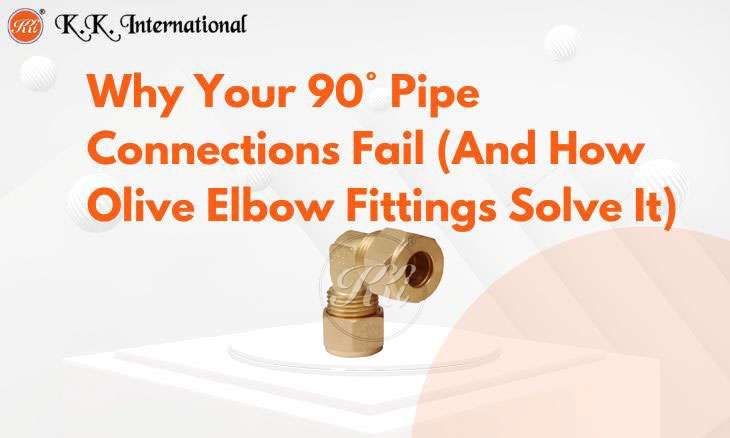
Strip away the technical language and it's pretty simple. This is a brass compression fitting made for creating tight, leak-proof 90-degree connections between pipes. No torch, no solder, no standing around waiting for a joint to cool before you can even test it.
The name gives away the design, once you know what to look for. "2N+2S" means two nuts and two sockets, and those work together to grip the pipe from both ends instead of just one. It's basically a belt-and-suspenders approach to sealing a joint, which is exactly why you'll see this style specified on jobs where a leak isn't just a nuisance but an actual hazard. Gas lines are the obvious example.
It's made from premium brass. That's not just a spec sheet detail, either. It's honestly the part of this whole guide worth spending the most time on.
Why the Material Actually Matters More Than People Think
Here's the thing nobody tells first-time buyers: the fitting material is what decides whether your installation lasts five years or fifteen. Not the labor, not even really the pipe itself.
Brass has been the go-to in plumbing and industrial work for a long time, and it's not because of tradition. It holds up. It doesn't corrode the way cheaper alloys do when they're exposed to moisture or rough outdoor conditions over time. It also doesn't warp under pressure, so you don't end up with those slow, sneaky leaks that show up months after everything's already sealed behind drywall. And frankly, it just doesn't need babysitting once it's in. You install it, you move on, and you don't think about it again.
If you've ever had to sit across from a client and explain why the "budget-friendly" fitting ended up costing them double in repair visits, you already know exactly why brass is worth the extra cost upfront.
Where You'll Actually End Up Using This
What makes this particular fitting worth keeping on your truck or in your supply room is how much ground it covers. It's not a one-trick product.
You'll find it doing solid work in everyday residential and commercial plumbing, the kind of standard water lines and bathroom or kitchen work most contractors handle weekly. It also shows up in gas and water pipeline work, where honestly, there's zero room for error on the seal. It holds its own in HVAC and refrigeration systems too, where tight, dependable joints matter for temperature control. And in hydraulic or industrial piping, where pressure is constantly testing every weak point in a system, this fitting is built to not be the thing that gives out first.
If your work bounces between a few of these categories in the same week, which honestly most contractors' work does, having one fitting that performs across all of them just makes life simpler. Fewer suppliers, fewer SKUs to keep track of, fewer surprises.
What You Should Actually Check Before Ordering
This is usually the part buying guides skip over, so let's not skip it.
First, confirm the pipe standard. This fitting is built around BSP, British Standard Pipe, so before you place an order, it's worth double, maybe triple, checking that your project's piping actually matches. Mismatched threading is one of those mistakes that seems small until it costs you a full day and a return shipment.
Second, get your sizing right. Compression fittings come in different sizes for a reason, and gas lines, hydraulics, and standard plumbing don't always call for the same diameter. Measure twice, order once. It sounds obvious, but it's still one of the most common headaches in bulk ordering.
Third, think about the actual pressure environment this is going into. A residential water line and a high-pressure hydraulic system are two completely different worlds, and knowing which one you're dealing with helps you pick the right grade with confidence instead of guessing.
Fourth, pay attention to build quality. This one's easy to overlook because, on the shelf, a lot of brass fittings look identical. Premium brass resists corrosion and holds a seal for years. The cheaper stuff can look the same on day one and fail within twelve months.
And if you're buying in bulk, ask about batch consistency. It's not just about one fitting being good. It's about every fitting in that box of 500 being just as good as the first.
Why This Beats a Standard Elbow Fitting
A regular elbow fitting works fine, until it doesn't. That's really the honest way to put it. The 2N+2S design gives you something a standard single-nut fitting just can't match: compression from two points instead of one. That's not a marketing detail, that's a mechanical advantage you can actually feel during installation and trust during inspection.
What that means for you day to day is fewer callbacks, less time spent chasing down a leak that shouldn't exist, and connections that hold steady even under vibration or pressure swings, which matters a lot more in HVAC and hydraulic setups than people realize. And every callback, as you already know, isn't just annoying. It costs you time, materials, and a little bit of your reputation every single time.
Bottom Line for Contractors
At the end of the day, a fitting is a small piece of a much bigger job, but it's also the piece most likely to be the reason you get called back if it's cheap. The Olive Elbow ASS (2N+2S) from KK International is built to take that risk off your hands entirely, with solid brass construction, a genuine double-grip design, and enough versatility to cover plumbing, gas, HVAC, and hydraulic work without switching products.
If you've got a project coming up and you'd rather not think twice about a fitting once it's installed, this is one worth having in your supply chain.
Need pricing, sizing details, or want to talk through a bulk order? Get in touch with the KK International team directly, they'll walk you through exactly what fits your project.


