
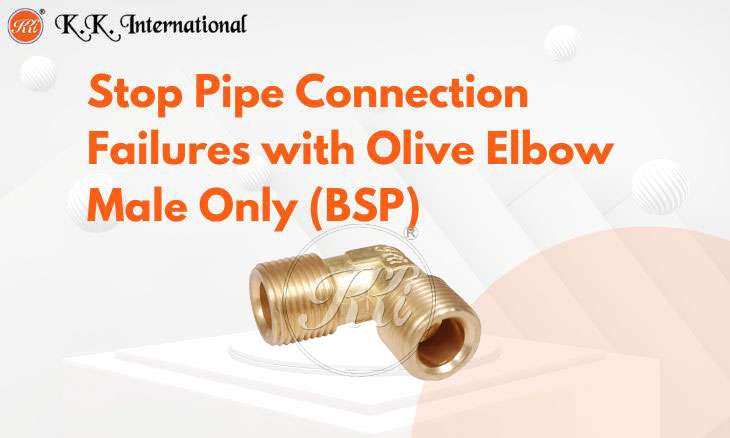
First Time Using Olive Elbow Male Only (BSP)? Read This First
So you've got this small brass fitting in your hand and honestly... you're not entirely sure what to do with it.
Maybe your plumber told you to grab one. Maybe you spent twenty minutes on Google trying to figure out what fitting you needed and somehow landed here. Maybe the guy at the hardware store handed it to you with a confident nod and zero explanation.
Doesn't matter how you got here. What matters is that before you start tightening anything, before you even touch a spanner, there are some things you really should know.
Trust me on this. Five minutes of reading right now saves you a very frustrated afternoon later.
What Even Is This Thing?
Okay let's start from zero because nobody explains this properly.
The Olive Elbow Male Only (BSP) is a brass compression fitting. That's the technical name. But what does it actually do?
Simple version: it connects a pipe to a threaded port while changing the direction of that pipe at the same time.
Think about it like this. Imagine your pipe needs to travel along a wall and then suddenly turn and connect to a valve or tap. You need something that handles both the turn and the connection simultaneously. That's exactly what this fitting does.
Now let's break that name down because honestly the name tells you everything once you understand it:
The word Olive refers to a small brass ring called an olive that creates the watertight seal when you tighten the fitting. You'll see it sitting there between the nut and the fitting body. That little ring does more work than it gets credit for.
The word Elbow simply means the fitting changes direction. Your pipe goes in one way and effectively exits at an angle - usually 90 degrees.
The word Male tells you the threaded end has external threads meaning it screws into something else, not the other way around.
Why Does This Specific Fitting Exist?
This is where most beginner guides skip straight to installation steps and miss the whole point.
Understanding why this fitting exists helps you understand when to use it and just as importantly when not to use it.
Pipes rarely run in perfect straight lines from point A to point B. They go around walls. They dodge beams. They navigate obstacles. And somewhere along that journey, they need to connect to things valves, taps, manifolds, other fittings.
When that connection point also happens to be where the pipe changes direction, you have two choices. You use two separate fittings one for the direction change, one for the connection. Or you use one fitting that handles both at once.
The Olive Elbow Male Only (BSP) is that second option. One fitting, two jobs, fewer potential leak points, cleaner looking installation, less space required.
In tight spaces under sinks, inside wall cavities, behind equipment this matters a lot. Every extra fitting is another potential leak point. Every extra fitting takes more space. Every extra fitting adds installation time.
This is why professional plumbers love elbow compression fittings. Not because they're fancy because they're practical.
The Brass Thing - Why It Actually Matters
Okay I know what you're thinking. "It's just a small brass fitting, how much does the material really matter?"
More than you'd expect. Here's why.
This fitting is going inside your wall. Under your floor. Behind your equipment. Somewhere you can't easily access once the job is done. And it's going to sit there for potentially decades dealing with whatever your pipes carry water, gas, chemicals, pressure fluctuations, temperature changes.
Brass handles all of that. Genuinely.
It doesn't rust like steel does. It doesn't crack under pressure like plastic can. It doesn't degrade when temperatures cycle between hot and cold. And here's something most people don't know brass machines really well, which means manufacturers can make these fittings to very precise dimensions.
Why does that matter? Because precise dimensions mean proper seals. The olive seat is exactly where it needs to be. The threads are cut to exact BSP tolerances. Everything fits together the way it's designed to.
Cheap fittings made from inferior materials often have inconsistent dimensions even if they look identical. And inconsistent dimensions mean unreliable seals. Which means leaks. Which means you're going back into that wall you just closed up.
KK International makes these fittings from premium brass specifically because the application demands it. Not marketing language — actual practical necessity.
How The Compression Part Actually Works
This confuses almost every first-timer so let's really slow down here.
You're used to connections that use solder, glue, or rubber gaskets. Compression fittings work completely differently. There's no heat. No adhesive. No rubber that eventually dries out and cracks.
Instead, a metal-to-metal seal is created by physically squeezing that small brass olive ring around your pipe.
Here's what's happening step by step when you tighten the compression nut:
The pipe slides into the fitting with the olive sitting around it like a ring around a finger. As you start tightening the compression nut, it pushes the olive forward toward the fitting body. The olive gets squeezed between the nut and the fitting seat. Because the olive is slightly softer brass, it deforms just enough gripping the pipe on the inside and conforming to the fitting seat on the outside. That deformation creates a completely metal seal that water and gas simply cannot get through.
No sealant needed on the compression end. No PTFE tape on this side. The seal is entirely mechanical.
And here's the beautiful thing about this: it works. A properly installed compression fitting handles significant pressure, resists vibration, and maintains its seal for decades without any maintenance whatsoever.
The BSP threaded end is different though. That end does need PTFE tape we'll get to that.
The Mistakes That Get First-Timers Every Time
Let's be honest about what goes wrong because forewarned is forearmed.
Forgetting the nut before inserting the pipe: already mentioned this but it's worth saying twice because it happens so often. Nut first. Olive second. Pipe into fitting third.
Rough or angled pipe cuts: spend the extra minute getting a clean square cut. Everything downstream of a bad pipe cut is harder.
Overtightening the compression nut: one-and-a-quarter turns past hand-tight. Memorize that. Resist the urge to go further.
Skipping PTFE tape on the threads: BSP threads don't self-seal. Tape every time without exception.
Reusing an old olive: if you ever disassemble a compression fitting for any reason, always fit a new olive when reassembling. The old one has already permanently deformed to fit the original pipe surface. It won't create a reliable seal again.
Not testing before closing up access: this one hurts the most when it goes wrong. Always test under working pressure before anything gets covered up.
One Last Thing Before You Start
Go slowly. Especially the first time.
Compression fittings reward patience and attention to detail. Clean pipe prep. Correct assembly order. Proper tightening. These aren't difficult steps they just need to be done right.
The fitting itself is doing most of the work. Your job is just to give it the conditions to work properly.
The Olive Elbow Male Only (BSP) from KK International: precision brass compression fitting for reliable direction changes across plumbing, hydraulic, and industrial applications. Manufactured to consistent BSP standards with quality brass that handles decades of real-world use without asking for anything in return.


