
Why Your Cooling Tower Isn't Performing (And How New Nozzles Fix It)
Something's off with your cooling tower and you can't quite pin down what.
Maybe your chiller's working harder than it used to. Maybe the water temperature coming out of the tower isn't dropping like it should. Maybe you've noticed energy bills creeping up even though nothing else in your system has changed.
You check the fans. You check the pumps. You check the basin water level. Everything seems mechanically fine. So what's going on?
Here's a possibility most people overlook entirely: your nozzles.
The Component Nobody Thinks About
Cooling towers get attention for their big visible parts. Fans, motors, fill media, basins these get inspected, maintained, and replaced when they show problems.
Nozzles? They're small. They're numerous. They're tucked up inside the distribution system where you can't easily see them. And honestly, most facility managers don't think about them until something obvious goes wrong.
But here's the thing nozzles are doing one of the most critical jobs in your entire cooling tower. They're responsible for taking the water coming through your distribution piping and spraying it evenly across the fill media below.
If that spray pattern isn't right, your entire cooling process suffers. Not dramatically at first. Just... gradually, quietly, in ways that show up as higher energy costs and reduced cooling capacity rather than an obvious failure you can point to.
How Cooling Actually Happens (And Why Nozzles Matter So Much)
Quick refresher on the basics, because understanding this helps you see exactly why nozzle condition matters so much.
Your cooling tower works by exposing water to air, allowing evaporation to remove heat. Hot water enters at the top, gets distributed across the fill media, trickles down through that fill while air moves through it, and the resulting cooler water collects in the basin at the bottom.
The efficiency of this entire process depends heavily on how evenly water spreads across the fill media. If water concentrates in certain areas and barely reaches others, you get uneven air-to-water contact. Some areas of your fill are doing all the work. Other areas are barely contributing to cooling at all.
This is exactly where nozzles do their critical work. A properly functioning nozzle creates a specific, even spray pattern that distributes water uniformly across its coverage area. When nozzles are working correctly, your entire fill media gets utilized properly, maximizing the air-water contact that creates actual cooling.
When nozzles aren't working correctly and we'll get into why that happens your fill media usage becomes uneven, your cooling efficiency drops, and your system has to work harder to achieve the same cooling result.
Why Nozzles Stop Performing Properly
Let's talk about what actually goes wrong, because understanding the failure modes helps you recognize the problem in your own system.
Mineral Scale Buildup
Cooling tower water typically contains dissolved minerals calcium, magnesium, various other compounds depending on your water source. As water evaporates in the tower, these minerals concentrate and can deposit on surfaces throughout the system.
Nozzles, with their small precision orifices, are particularly vulnerable to this scale buildup. Even minor scaling inside a nozzle changes its spray pattern. The carefully designed orifice that was creating an even distribution pattern now has restricted or altered flow, creating an uneven spray.
Corrosion Damage
Standard water treatment chemicals, combined with the wet-dry cycling that nozzles experience, create a genuinely corrosive environment. Lower quality materials degrade under this exposure the nozzle surface roughens, dimensions change slightly, and spray performance deteriorates.
This is actually one of the strongest arguments for quality brass construction, which we'll get into shortly.
Physical Wear and Erosion
Water moving through nozzles at velocity, especially water carrying any particulate matter, gradually erodes nozzle surfaces over time. This erosion changes the precise dimensions that were creating your designed spray pattern.
Debris and Partial Blockage
Cooling tower water systems aren't perfectly clean environments. Small debris, biological growth, and particulate matter can partially clog nozzle orifices. Even partial blockage significantly affects spray pattern and distribution.
Material Degradation Over Time
Cheaper nozzle materials certain plastics, lower grade metals simply don't hold up to years of continuous exposure to treated water, UV exposure if applicable, and the temperature cycling inherent in cooling tower operation. They become brittle, develop micro-cracks, or warp slightly all of which affect spray performance.
How to Actually Tell If Your Nozzles Are the Problem
Before assuming nozzles are your issue, here's how to actually check.
Visual Inspection During Shutdown
During scheduled maintenance, physically inspect nozzles. Look for visible scale buildup, corrosion, cracking, or obvious damage. Check if spray orifices appear clear or partially blocked.
Spray Pattern Observation
If possible, observe the actual spray pattern during operation sometimes through an access point or during startup before full water flow. Uneven distribution, certain areas getting heavier spray than others, or visibly altered spray patterns compared to what the nozzle should produce all indicate problems.
Fill Media Inspection
Check your fill media condition. Areas receiving inadequate water distribution often show different wear patterns, different scale buildup, or different biological growth compared to areas receiving proper water coverage.
Performance Trending
Look at your cooling tower's performance data over time if you have it. Gradually declining approach temperature performance, gradually increasing energy consumption for the same heat rejection load, these trends often point toward distribution system degradation including nozzle condition.
Age and Maintenance History
If your nozzles haven't been inspected or replaced in several years, and you're experiencing any performance concerns, nozzle condition is a reasonable place to start investigating, especially if other obvious causes have been ruled out.
Why Brass Construction Actually Solves These Problems
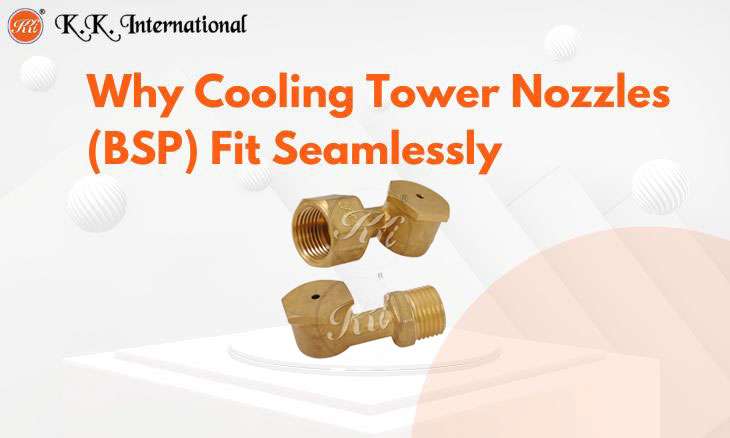
The Cooling Tower Nozzles (BSP) from KK International are manufactured from premium brass specifically because this material addresses the failure modes we just discussed.
Corrosion Resistance Where It Actually Matters
Brass naturally resists the corrosive effects of treated cooling tower water far better than many alternative materials. This isn't marginal improvement it's a fundamental difference in how the material behaves in this specific chemical environment.
The corrosion resistance means your nozzle dimensions and spray orifice geometry remain stable over years of operation, rather than gradually degrading as corrosion eats away at critical surfaces.
Dimensional Stability Under Operating Conditions
Cooling towers experience continuous wet-dry cycling, temperature variation, and constant water flow. Brass maintains its precise dimensions through all of this. The spray orifice that was engineered to create a specific pattern stays that exact size and shape.
This matters enormously because nozzle performance is fundamentally about precision dimensions. A slightly worn or corroded orifice doesn't fail completely it just performs differently than designed, and that's exactly the gradual degradation that's so hard to notice until you measure actual efficiency impact.
Resistance to Mineral Scale Adhesion
While no material is completely immune to scale buildup in hard water conditions, brass surfaces tend to resist scale adhesion better than some alternatives, and scale that does form is typically easier to remove during cleaning maintenance without damaging the underlying nozzle surface.
Long Service Life Reducing Replacement Frequency
Quality brass nozzles simply last longer in cooling tower service than budget alternatives. This means less frequent replacement, less maintenance downtime, and more consistent performance over the operational life of your cooling tower.
The Bigger Picture on Cooling Tower Efficiency
Nozzles are obviously just one component in a complex system. Fan condition, fill media condition, water treatment quality, and overall system design all contribute to cooling tower performance.
But nozzles deserve more attention than they typically receive precisely because they're easy to overlook. They're small, numerous, and tucked away from casual observation exactly the kind of component that degrades quietly while bigger, more visible components get all the maintenance attention.
If you've addressed the obvious stuff fans running properly, adequate water flow, reasonable fill media condition and you're still seeing performance that doesn't match expectations, nozzle condition is genuinely worth investigating before assuming the problem lies elsewhere or accepting reduced performance as just how the system is now.
Ready to Address Your Cooling Tower Performance?
If your cooling tower isn't performing the way it should, and you've ruled out the obvious mechanical issues, your nozzles might be exactly the overlooked component causing that performance gap.
The Cooling Tower Nozzles (BSP) from KK International: precision-engineered brass construction for corrosion resistance and dimensional stability, optimized spray design for uniform water distribution, leak-proof BSP threading for straightforward installation, and the durability that keeps your cooling tower performing at its designed efficiency for years rather than months.


