
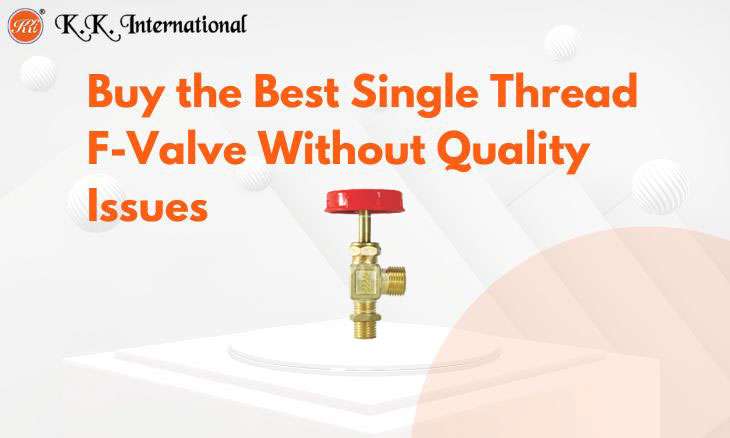
F-Valve (Single Thread) vs Standard Fittings: What's the Difference?
You're at the hardware store, staring at a wall of LPG fittings. Or maybe you're scrolling through pages of options online. And honestly? You have no idea which one you actually need.
They all look pretty similar. Brass fittings, various sizes, technical terms you don't fully understand. Single thread, double thread, standard connections what does any of that even mean when you just want to connect your gas cylinder safely?
And here's the uncomfortable part: this isn't like buying the wrong light bulb where the worst case is you return it. We're talking about gas connections. Getting this wrong could be dangerous.
So let's figure this out together, in regular language, without all the technical jargon that assumes you already know what you're looking for.
What Are We Even Comparing Here?
Okay, so first thing: "standard fittings" is kind of a vague term. It's like saying "standard car" could mean a lot of different things depending on who's talking.
Most people use "standard LPG fitting" to describe those basic brass pieces that join two things together. A hose to a regulator. One pipe section to another. They're basically connectors point A meets point B, and gas can flow through.
That's it. They don't do anything else. No on/off switch, no flow control, just a path for gas to move through.
The F-Valve (Single Thread) is different because it's not just sitting there connecting stuff. It's actively controlling whether gas flows or not. You can turn it on, you can turn it off. It's a control point, not just a connection point.
Think of it this way: standard fittings are like permanent hallways in a building always open, always passable. The F-Valve is like a door you decide when it's open or closed.
When Do You Need Control vs Just Connection?
This is really the key question, right? Because if you don't need to control gas flow at a certain point, why pay extra for a valve?
Situations Where a Simple Fitting Makes Sense:
Let's say you're connecting your regulator straight to your main gas line, and you don't need to shut off that specific connection separately from everything else. A fitting does the job fine.
Or maybe you're extending a hose by a few feet. You're not creating a control point you're just making the hose longer. Standard fitting handles that.
Basically, anywhere you're just joining things together and those things operate as one unit, fittings work.
When You Actually Want That Control:
Now imagine you've got a workshop with multiple tools running off one LPG source. Welder, heater, maybe a torch setup. You want to shut off the heater without affecting the welder? You need a valve on each branch.
Or think about a home where LPG runs both the kitchen stove and the water heater. Maybe during summer you're barely cooking and want to shut off the kitchen line entirely for safety. Can't do that with just fittings you need a valve.
The F-Valve gives you that "shut this off, but leave that on" capability. That's genuinely useful in real situations, not just theory.
This "Single Thread" Thing
Alright, let's talk about what "single thread" actually means, because I know this confuses people.
It's referring to how the valve connects to your system specifically, the type of threaded connection it uses. The F-Valve (Single Thread) is designed for single-thread LPG connections, typically in the 1/4" x 3/8" size range that's really common in gas systems.
This isn't about it being "limited" or "basic." It's about it being designed for specific applications where that connection type is what you've got. It fits properly, seals correctly, and does its job in systems using that threading standard.
Standard fittings come in all sorts of connection types. Some are threaded differently. Some use compression connections. Others might be push-to-connect designs. Lots of variety, which is great until you're trying to figure out which one actually fits your setup.
The single-thread F-Valve is straightforward if your system uses that connection type (and many do), this fits. Done.
The Safety Stuff Nobody Wants to Think About
Look, I know safety discussions can feel preachy. But we're dealing with pressurized flammable gas, so let's talk about this honestly.
Having an Off Switch Matters
With the F-Valve, if something goes wrong downstream—a hose starts leaking, equipment acts weird, you just smell gas and something feels off you can shut off that specific section immediately.
With only standard fittings? You'd have to trace back to wherever your main shutoff is, which might kill gas to everything. In an emergency, those extra seconds matter. And practically speaking, being able to isolate one problem area while keeping everything else running is just smarter.
Better Engineering for Gas
Both good fittings and good valves should seal properly when installed right. But the F-Valve from KK International is specifically engineered as a gas control device. The brass composition, the threading precision, the internal design it's all built for LPG pressures and conditions.
Some cheap "standard fittings" are basically generic plumbing parts that kinda work with gas. They might be fine, or they might not. The F-Valve is purpose-built for this exact job.
Quick Response When Things Get Weird
Equipment fails. Hoses develop problems. Stuff happens. Having valves at key points in your system means you can react fast. Close the valve, assess the situation, fix the problem all without shutting down your entire gas supply.
That's practical safety that makes a difference in how you can actually manage your system.
Actually Installing These Things
Standard fittings are definitely simpler to install. They don't have moving parts or valve mechanisms. You thread them on with proper sealant, tighten everything correctly, and you're done. There's not much to think about.
The F-Valve requires a tiny bit more thought. You need to know which way opens and closes it usually pretty obvious, but still. And you should think about positioning so you can actually reach the valve when you need it. Having a shutoff valve you can't access in an emergency kind of defeats the purpose.
But honestly? It's not complicated. If you can install a standard fitting, you can install the F-Valve. You're just adding one extra consideration: how will I actually use this valve when I need to?
So Which One Do You Actually Need?
Ask yourself:
Do I need to control gas flow at this specific point? If yes valve. If no fitting.
Might I need to shut off this section independently for safety or maintenance? If yes valve.
Is this a critical connection where extra safety features are worth the cost? If yes valve.
Am I just joining two things that always work together as one unit? If yes fitting is fine.
For most people, the smart setup uses F-Valves at strategic spots main feeds, branch points, equipment connections and standard fittings for simple pass-through connections that don't need individual control.
That gives you control where it matters without spending unnecessarily on every single connection point.
Here's the Actual Bottom Line
The F-Valve (Single Thread) and standard fittings aren't in competition. They serve different purposes, and most good gas systems use both appropriately.
Standard fittings connect things. That's their job, and they do it fine when that's all you need.
The F-Valve connects things AND gives you control over flow. When you need that control for safety, for operational flexibility, for maintenance access it's the right choice.
The F-Valve (Single Thread) from KK International gives you precision connections designed for LPG, durable brass construction that lasts, leak-proof operation for safety, and flow control when you need it. Use it where control matters, and you'll have a safer, more flexible gas system.


